How do the requirements of the EU Deforestation Regulation (EUDR) impact the competitiveness of the EU livestock sector? The EUDR includes a range of soy products in its scope of relevant products, which are globally traded and widely used in animal feed production across the world. The inclusion of soy has indirect consequences for the competitiveness of EU livestock production, as compliance costs for soy meeting the EUDR requirements will have to be absorbed by the livestock value chain. These are costs that third countries exporting animal products to the EU do not have to make. In relation to livestock, the EUDR also includes cattle and cattle meat products, which has implications for how EU cattle farmers and those who place cattle meat products on the EU market need to organise themselves. And while farmers and industry are preparing to meet with EUDR requirements, the key question is also how national competent authorities will tackle enforcement.
Opening the session, co-chair MEP Maria Grapini stressed that Europe’s rural areas need real investment behind its ambitions, not just more measures. Speaking from her own experience as a former entrepreneur, she argued that a dedicated innovation and research budget for the bioeconomy must be secured in the next EU budget, warning that investor confidence depends on long-term policy predictability rather than measures that shift after a single year. Turning to the day’s topic, she flagged the EU Deforestation Regulation (EUDR) as necessary in principle but heavily consequential for agriculture, given the scale of the sanctions attached to it, and called on the Intergroup’s three co-presidents — representing different political groups but a shared seat on the Agriculture Committee — to keep pushing for fair competition alongside environmental protection, particularly as the EU negotiates trade deals such as Mercosur.
Framing the debate, MEP Benoit Cassart traced the EUDR back to its origins: according to the FAO, almost 90% of global deforestation is linked to agricultural land conversion, and the EU remains a major importer of associated commodities — soy (mainly for animal feed), palm oil, cocoa, coffee and beef among them. Yet European forest cover has actually grown by an area comparable to Greece since 1990. Because WTO non-discrimination rules ruled out applying the regulation to imports alone, European producers were brought into scope too — meaning a French, Belgian or Irish farmer now faces the same administrative obligations as an operator importing beef from recently deforested land in Brazil, at a moment when the EU is also pursuing a Mercosur deal that studies suggest could increase deforestation pressure. The question put to the room: how to reconcile the fight against deforestation with the competitiveness of a sector that already carries some of Europe’s highest structural costs.
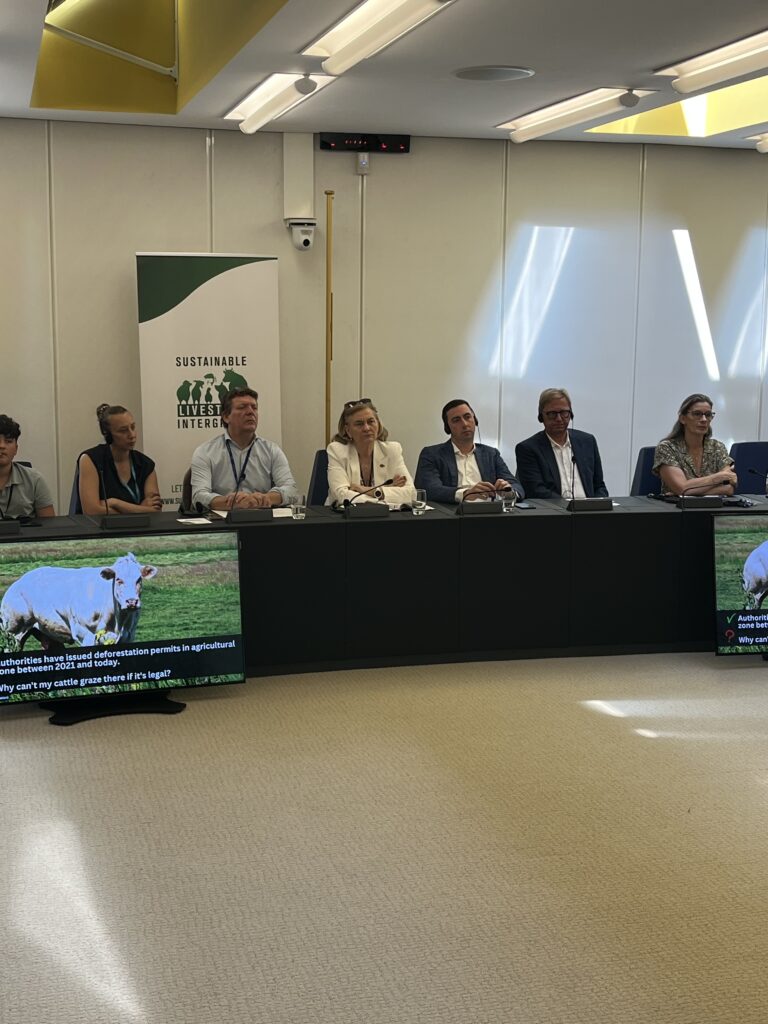
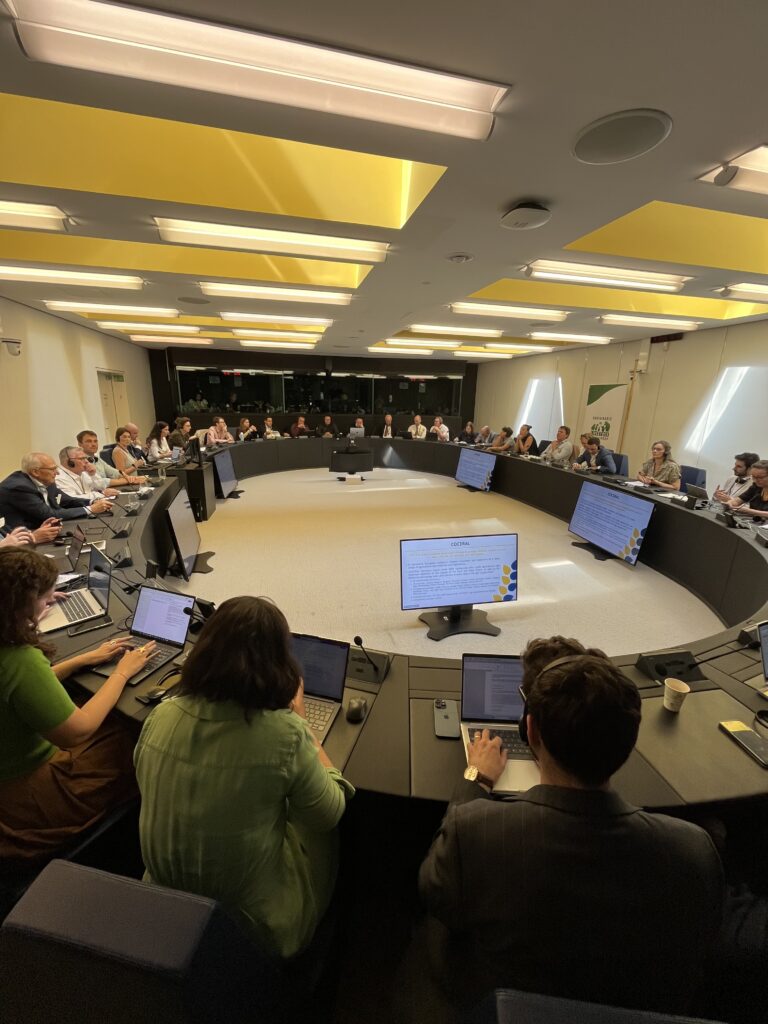
MEP Alexander Bernhuber, co-president, welcomed participants and reflected candidly that when the file was adopted in 2021, few appreciated how much bureaucracy it would generate for farmers, landowners and cattle breeders who have no deforestation problem to begin with. He credited the past two years of work with limiting the burden on primary producers “to a very limited stage,” but stressed that implementation is now the real test — calling for flexibility without losing ambition.
MEP Asger Christensen, speaking in Danish on behalf of Danish farmers, said the Commission’s simplification package is “a step in the right direction,” but warned that what remains on the table is still “a bureaucratic monster.” IT costs and supply-chain complexity will ultimately be passed down to farmers and consumers, he said, while noting that Denmark is actively increasing forest cover from 15% to 25% — proof, he argued, that Europe is not the problem this regulation was designed to solve.
For the Commission, Monika Hencsey, Director for Green Diplomacy and Multilateralism at DG Environment, defended the EUDR as “a rather game-changing regulation from an environmental protection point of view,” while acknowledging the implementation challenges that led to two postponements. She pointed to the 4 May simplification review, which reduced administrative burden without reopening the legislative text, and clarified that soy is in scope because it drives roughly a third of EU-linked deforestation, while no other livestock feed is covered. Among the concrete simplifications: member states with adequate national data systems can now feed that data directly into the EU system, rather than requiring farmers to submit fresh declarations.
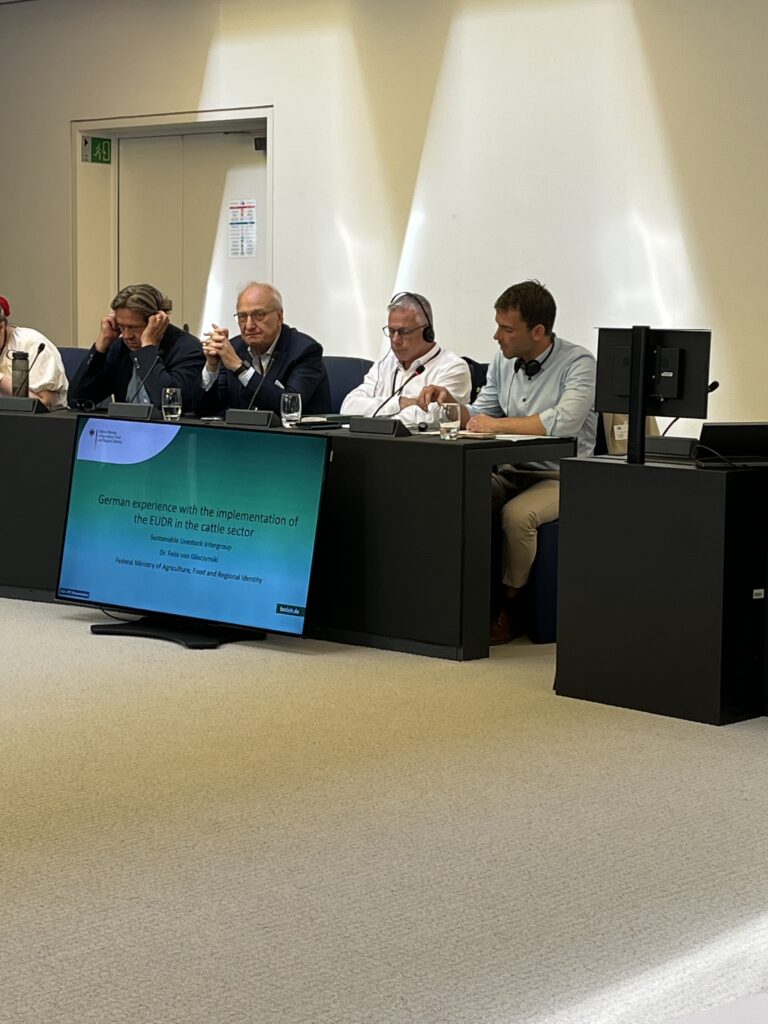
Germany’s perspective came from Dr Felix von Glisczynski of the Federal Ministry for Food and Agriculture, who set out how Germany is preparing to make compliance near-invisible for cattle farmers. Using the existing national cattle identification and registration system, declarations will be pre-filled and submitted with a single click, with the reference number passed automatically down the supply chain — reducing the additional burden on German cattle farmers “to almost zero,” he said. He confirmed Germany’s simplified one-time declaration now covers 99% of the country’s cattle farmers, but flagged that a reliable, high-performing EU IT system and a genuine level playing field across member states remain the outstanding tasks before the regulation enters into force at year-end.
Bringing the debate to farm level, Daniel Coulonval, President of the Wallonian Agricultural Federation, described a catalogue of unresolved definitional questions: what counts as a forest, what counts as deforestation, and how historic land-use changes — including shrubland reverted to grassland, or land once used for Christmas trees — should be treated. He pressed the practical stakes with a stark example: a cow arriving at a slaughterhouse without the correct documents cannot legally leave alive, yet no one has told farmers what happens next. His federation’s position: territorial zoning should be settled at national level and should not shift under a new EU regulation, and member states — not farmers — should carry the administrative load. On cost, he cited an estimated €900,000 for Belgium alone and asked pointedly who will pay for it.
From the soy trade, Giorgio Dalla Bona, Vice President of COCERAL and CEO of Cereal Docks International, delivered what the chair called “a real alarm call.” He said his own company has spent €2 million over two years on auditors, staff and IT systems to prepare for compliance — investment he said risks being wasted given the uncertainty still surrounding the system due to launch in September. He warned that full segregation of supply chains, as currently designed, could disrupt sourcing entirely: Brazil supplies volumes no other origin — not the US, Argentina, or Ukraine — can replace, with normal soy already carrying an estimated 8–15% cost premium. Without changes to how the commodity flow itself is controlled, he said, “we can’t survive in a world like this.”
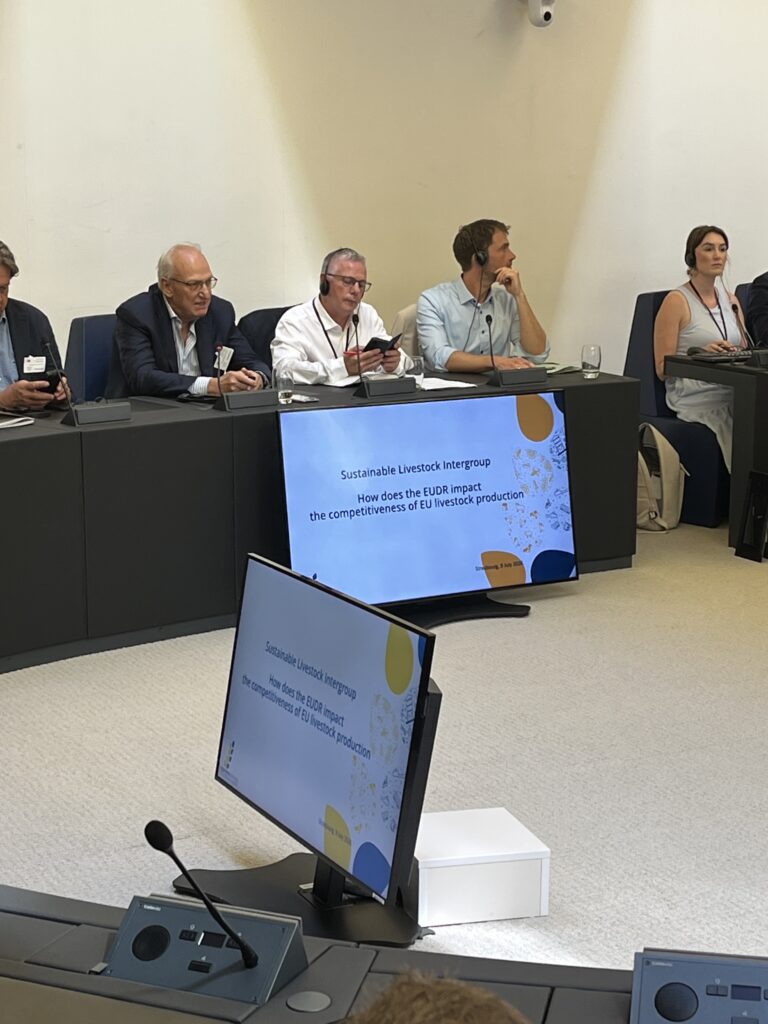
The Q&A surfaced sharper political frustration. MEP Christine Singer described a total lack of clarity on implementation in Belgium and Germany alike (“nobody knows how it will develop”), while other MEPs criticised the absence of a proper impact assessment and warned of a wider pattern of EU legislation — pointing to the upcoming methane regulation as the next flashpoint.
Opening the floor for comments, MEP Benoit Cassart invited Alexander Döring, Secretary General of FEFAC, to speak. He added that the European feed industry has run its own benchmarking programme for over a decade, verified through a WTO-linked partner in Geneva, with more than 95% of EU soy usage already shown not to be linked to deforestation. His plea: recognise existing, third-party-verified private certification schemes rather than building a parallel system from scratch. A cereals-sector representative, Sylvain, proposed a more structural fix — using the data farmers already submit through CAP declarations to cover EUDR (and biofuel) sustainability requirements, avoiding duplicate paperwork altogether.
Responding to the questions and comments raised, Ms Monika Hencsey underlined that small and micro operators have until 30 June 2027 to comply, that the EU Information System is already open for testing, and that downstream operators no longer need to duplicate due diligence statements already filed further up the chain — addressing a repeated complaint from the floor. She confirmed a certification repository is due online by year-end to support, though not replace, compliance checks.
Pressed directly on whether the EUDR simply displaces deforestation — for instance, by freeing up Brazilian soy for the Chinese market instead — Ms Hencsey argued the regulation is already inspiring similar traceability schemes among EU trading partners, even if it cannot govern trade between third countries directly.
Closing the session, MEP Stefan Kohler welcomed the discussion but voiced concern that the Commission’s IT system may not be fit for purpose at this scale, citing reports that even a company the size of IKEA has overloaded the system with its documentation. He proposed that the Intergroup’s political groups jointly write to the Commission, warning that if the system cannot function, implementation should be paused rather than forced through.
Co-chair MEP Benoît Cassart closed the meeting by underlining the scale of what’s at stake with two vivid examples from the floor: a single shipment from Brazil generating paperwork equivalent to 12 million individual plots, and a biscuit manufacturer sourcing from 25,000 smallholder cocoa producers in Africa who cannot realistically absorb the same documentation burden as large operators. “There is good will,” he said, “but a real dysfunction between the regulation as written and the reality in the field.” He thanked the more than 200 participants who joined online, and closed with a call to keep working towards practical solutions.
Download the speakers presentations :
The Common Agricultural Policy (CAP) must remain a central framework to support European agriculture and the conditions to enable farmers
How do the requirements of the EU Deforestation Regulation (EUDR) impact the competitiveness of the EU livestock sector? The EUDR
Momentum for progressive investment in more sustainable farming systems has slowed down or even stopped due to over restrictive and burdensome